How Do You Winterize a Pier Water Line Before Freezing Temperatures?
Preventing Leaks and Water Damage
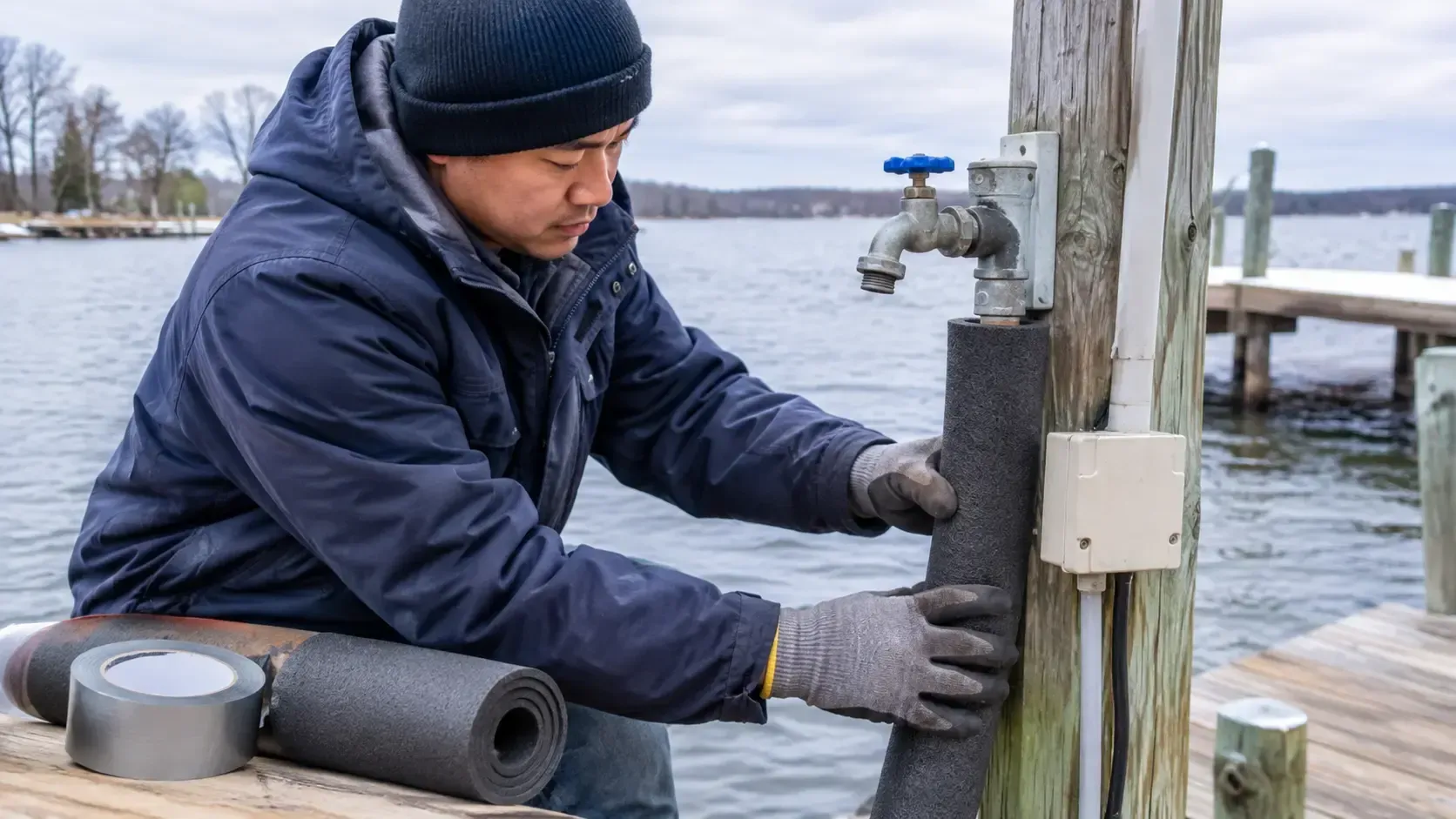
Table of Contents
- Introduction
- Why Pier Lines Freeze When Your House Plumbing Does Not
- How to Winterize a Pier Water Line, Step by Step
- The Places Water Hides After You Think You Drained It
- Hose Bibs, Vacuum Breakers and the Parts People Forget
- What to Do If the First Freeze Already Got There
- Turning the Pier Line Back On in Spring
- Conclusion
- Book Pier Winterization Before the Weather Turns
- Frequently Asked Questions
Key Takeaways
- Shut off, drain, leave the spigots open. That order, and before the first hard freeze.
- Water expands when it freezes, and a closed section of pipe has nowhere to put it.
- A hose left attached will hold water against the bib and undo the whole job.
- The damage almost never shows in winter. It shows the day you turn the water back on.
- If your only shut-off valve is out on the pier, that is a summer project, not a December one.
Introduction
Shut the supply off at the house, drain the entire run, and leave the dock spigots open, all of it before the first hard freeze, which for waterfront homes around Mayo and Riva is the difference between a quiet spring and a split pipe under the decking.
That is the short version of how to winterize a pier water line, and it is on our pier page already. The long version is where the pipes actually break, because almost nobody gets all the water out on the first try.
Why Pier Lines Freeze When Your House Plumbing Does Not
Because every inch of a pier line sits outside the part of your property that stays warm.
Your indoor plumbing is wrapped in a heated building. Even the pipe in an unheated crawl space borrows warmth from the floor above it. A pier line has none of that. It runs out of the house, across the yard, down the bulkhead and out along the decking. It spends the whole winter at whatever temperature the air decides on.
Three things make it worse than a regular outdoor faucet:
- The run is long and mostly horizontal. Long horizontal pipe drains slowly and holds water in any low spot, and piers settle, so low spots appear over time whether the original installer left one or not.
- It is exposed to wind off the water. Moving air pulls heat out of a pipe far faster than still air does, and there is not much shelter on a pier in January.
- Nobody is using it. A line you run water through daily is constantly refreshed. A line nobody has touched since October is a sealed tube of still water waiting for a cold night.
Water expands as it turns to ice. In an open line that expansion has somewhere to go. In a closed section it has nowhere, and the pipe or the fitting gives way. That is the whole mechanism, and it is why "leave the spigots open" is not an afterthought on the list.
How to Winterize a Pier Water Line, Step by Step
Four steps, in this order, on a day you are not rushing.
- Shut off the supply to the pier at the house end. Find the valve that isolates the pier run, close it fully, and leave yourself a note about where it is while you are standing in front of it. Next November you will not remember.
- Open everything downstream. Every dock spigot, every hose bib on the run, every drain or blow-off fitting the installer left you. Air has to get in before water will come out.
- Drain the run and walk it. Let gravity do the work, then go out along the pier and look for sections that are still holding. Tapping a line tells you plenty: full pipe sounds dull, empty pipe does not.
- Leave it open all winter. Spigots stay open, valves downstream stay open. This is the step people undo in February when the handles look untidy, and it is the one doing the most work.
Some systems get blown out with compressed air instead of drained by gravity. That is the right call on a long run with a stubborn sag in it. It is also worth having done properly rather than improvised, because too much pressure will damage fittings, and some plastic lines do not tolerate it at all.
One thing to skip entirely: do not pour automotive antifreeze into a line that connects to your drinking water. If you think your layout genuinely needs a potable antifreeze somewhere, ask first.
The Places Water Hides After You Think You Drained It
This is where the job usually fails, and all four are things you can check yourself in ten minutes.
- The sag in the middle of the run. Pipe strapped under pier decking follows the pier, and piers move. A section that drained perfectly five winters ago may be holding a cup of water now.
- The riser at the shoreline. Where the line comes up out of the ground or over the bulkhead there is almost always a vertical section, and vertical sections hold whatever is below the drain point.
- The body of the spigot itself. Opening the handle does not guarantee the casting behind it is empty, especially on an older bib mounted level rather than with a slight fall.
- Inline devices. Filters, quick-connects, check valves and backflow fittings all have an internal chamber. Each one is a small reservoir, and each one is expensive to replace compared with the pipe around it.
None of these holds much water. That is exactly the problem, because a small amount of trapped water is enough to split a fitting, and a split fitting leaks just as thoroughly as a split pipe does.
Hose Bibs, Vacuum Breakers and the Parts People Forget
Two components cause most of the calls we get, and both of them get overlooked because they are not really thought of as pipe.
Leave a hose attached and the rest of the job does not matter. A hose full of water sits against the back of the bib and keeps it from draining, and that holds true even for frost-free sillcocks, which are designed to shut off back inside the warm wall. The hose defeats the design. Disconnect every hose, drain it, and store it somewhere it will not freeze into a solid coil.
Vacuum breakers and backflow devices need the same attention. Our pier page notes that a vacuum breaker on a dock spigot keeps hose water from siphoning back into the house supply, which matters more here than most places given what people rinse off on a dock. That device has a body with water sitting in it. Some are built to drain themselves and some are not. The ones that are not will crack, then quietly fail open in spring. Your backflow protection is gone and nothing tells you.
While you are out there, look at where your shut-off valve lives. If the only valve controlling the pier run is mounted out on the pier, it is sitting in the freeze zone it is supposed to protect you from. Relocating it inside is a straightforward summer job and it makes every winter after that simpler.
What to Do If the First Freeze Already Got There
Nothing dramatic, and nothing involving a torch.
If you find a frozen section, shut the supply off first so that whatever gives way does not do it under pressure. Never thaw a pipe with an open flame, which is the single most common way a frozen pipe turns into a structure fire. Gentle warmth and patience are the only safe approach, and on an exposed pier line the simplest answer is usually to wait for the weather.
The important part is what happens next. A freeze split rarely leaks while it is frozen, because the ice is plugging the hole it just made. It leaks when things warm up and water comes back. So when you do turn the supply on in spring, be standing there watching the run rather than turning the valve and walking inside.
If the line does fail, the repair is usually a section replacement rather than the whole run, which is ordinary water pipe repair work and not the catastrophe people assume when they see water coming through the decking.
Turning the Pier Line Back On in Spring
Slowly, and with someone watching the far end.
Before you open the valve, walk the length of the run and look for anything that has moved, split, pulled loose or corroded over the winter. Reattach hoses last, not first.
Then open the house valve part way and let the line fill gradually instead of hitting it with full pressure. Watch the spigots as they start to spit air, listen for running water where there should not be any, and check the fittings you know are oldest.
Afterward, pay attention to how the pier spigot performs. A noticeable drop in pressure out there is one of the warning signs we list on the pier page, and it usually means either a partial blockage from winter debris or a leak somewhere between the house and the dock. If the whole house feels weak rather than just the pier, that is a different problem and low water pressure in older homes around here has its own set of causes.
Conclusion
Put it on the calendar instead of waiting for a forecast, because the first hard freeze around the bay has a habit of arriving on a weekend when the hose is still out and nobody feels like walking to the end of a cold pier. An hour in November beats a repair in April, and the only tools most of this needs are a valve key and the willingness to go look at the parts you would rather assume are fine.
Book Pier Winterization Before the Weather Turns
If your pier run has an awkward sag, a shut-off valve in the wrong place, or a line that has already split once, that is worth handling before the cold settles in. We do
pier winterization, dock water line installation, hose bib service and repairs for waterfront properties, and we have been doing it in Anne Arundel and Northern Calvert Counties since 1980. Free same business day estimates, fully licensed and insured, four generations of Maryland master plumbers. Call (410) 798-4469 or
schedule service. We serve Edgewater, Tracys Landing, Dunkirk, Owings, Chesapeake Beach, North Beach, Riva and Mayo.
Frequently
Asked Questions
When should a pier water line be winterized?
Before the first hard freeze rather than after the first cold snap. Around the Chesapeake that usually means doing it in November while the weather is still comfortable, not waiting for a forecast that gives you a day or two of notice.
Do I have to leave the dock spigots open all winter?
Yes. An open spigot gives expanding ice somewhere to go and lets any remaining water escape instead of splitting a fitting. Closing the handles mid winter because they look untidy undoes most of the protection.
Will a frost-free hose bib protect a pier line on its own?
No. A frost-free bib shuts off further back where it is warmer, but it cannot drain with a hose attached, and it does nothing for the long exposed run of pipe out to the dock. The line still has to be drained.
How do I know if my pier line froze and split?
Usually you do not until spring. Ice plugs the split while it is frozen, so the leak appears when water comes back. Turn the supply on slowly, stand where you can see the run, and look for water under the decking.
Can I use antifreeze in a pier water line?
Not automotive antifreeze, ever, in a line connected to your drinking water. Draining the run is the normal approach. If your layout makes draining difficult, ask a plumber before adding anything to the system.