How Do You Know If Your Home's Pipes Need to Be Replaced?
Preventing Leaks and Water Damage
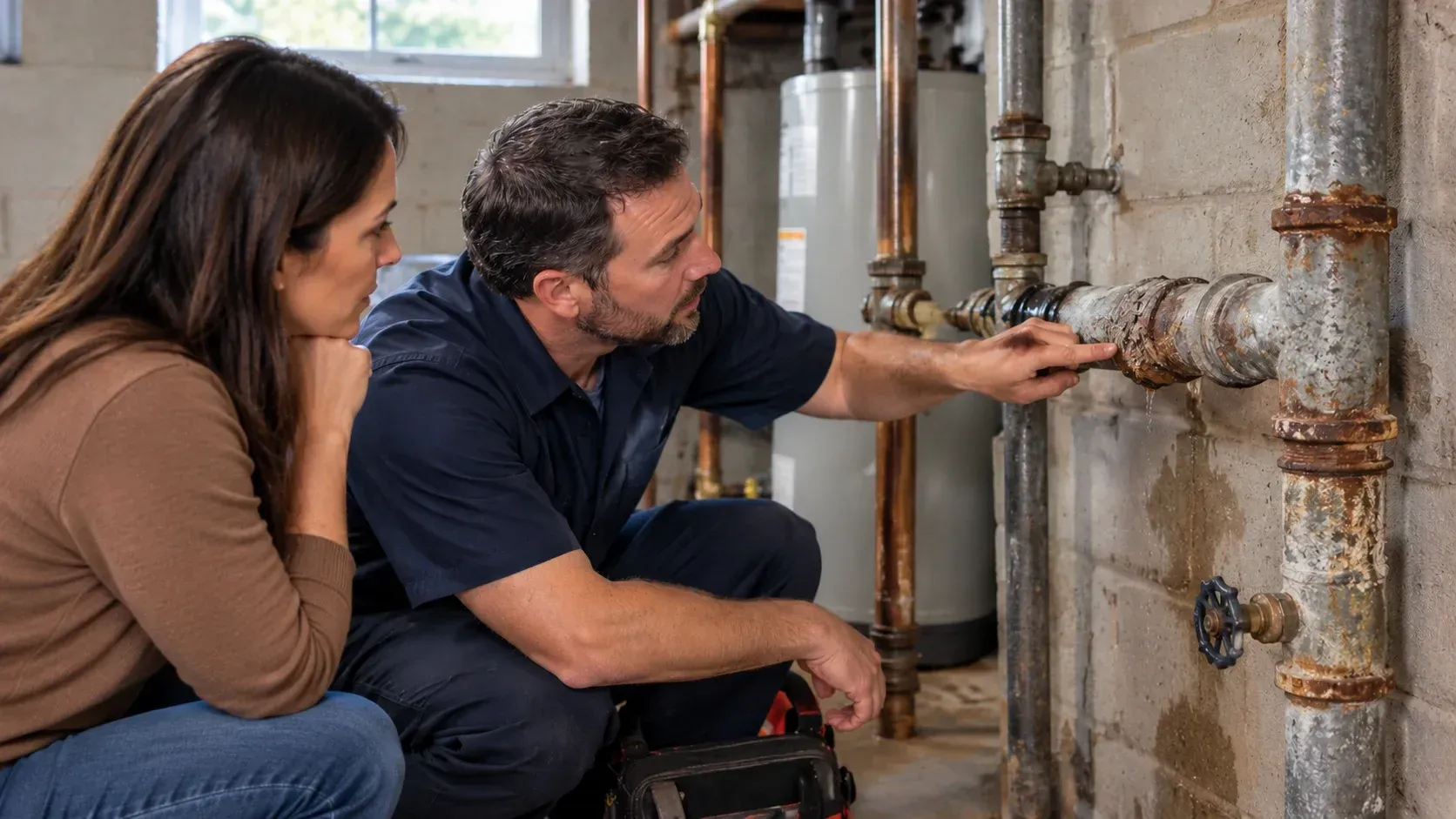
Table of Contents
- Introduction
- When Pipes Need to Be Replaced Rather Than Repaired
- Pipe Material Is the Biggest Clue You Have
- Signs of Bad Pipes You Can See at the Tap
- Pipe Corrosion Symptoms Hiding Inside the Wall
- Whole House or Partial, and How to Decide
- What a Plumber Checks Before Recommending Replacement
- Conclusion
- Get a Free Same Day Estimate
- Frequently Asked Questions
Key Takeaways
- One leak is a repair. Repeat leaks in different places are a material problem.
- What your pipes are made of tells you more than how old the house is.
- Polybutylene and galvanized steel are the two materials that most often justify full replacement.
- Rusty water, falling pressure across the whole house, and pinhole leaks are the three symptoms that matter most together.
- Replacing in sections is often the right call, and a good plumber will say so rather than quoting the whole house by default.
Introduction
Your pipes need to be replaced when the material itself is failing throughout the system rather than in one spot, and the clearest evidence is repeat leaks appearing in different places over a short period. A single leak at a joint is a repair. Three leaks in two years, in three different parts of the house, is the pipe telling you something about all of it.
For homes across Anne Arundel and northern Calvert County, the question usually arrives after a leak, which is the worst moment to be deciding. Knowing the signals ahead of time turns an emergency into a plan.
When Pipes Need to Be Replaced Rather Than Repaired
Replacement becomes the better answer when the failures stop being isolated events and start forming a pattern.
The pattern looks like this:
- Repeat leaks in different locations rather than one recurring spot
- Pinhole leaks in copper, which rarely arrive alone
- Discolored water that appears after the water has sat, especially from multiple fixtures
- Falling pressure throughout the house rather than at one tap
- Visible corrosion, flaking, or green and white deposits on exposed pipe
- A material with a known failure history already in the walls
One of these is worth a conversation. Several together usually means money spent on repairs is money spent twice, because the next failure is already forming somewhere you cannot see.
Pipe Material Is the Biggest Clue You Have
What the pipe is made of predicts its future better than the age of the house does, because different materials fail in different ways and on different schedules
| Material | How it tends to fail | Replacement usually driven by |
|---|---|---|
| Galvanized steel | Corrodes from the inside, narrowing the bore | Pressure loss and rusty water |
| Polybutylene | Degrades and fails at fittings, often without warning | Known failure history, insurance concerns |
| Copper | Pinhole leaks, accelerated by acidic water | Repeat pinholes across the system |
| CPVC | Becomes brittle with age and heat | Cracking at joints |
| PEX | Generally durable, failures usually at fittings | Installation issues rather than material |
Galvanized steel is the one that produces the slow decline most homeowners recognize. It rusts inward, so the pipe looks fine from outside while the opening narrows. Pressure falls gradually, the water picks up rust, and once that corrosion starts there is no reversing it.
Polybutylene is the one that deserves separate attention. It was installed widely for a period and then abandoned because of its failure record, and removing it is a service we perform specifically. If you have it, the question is usually when rather than whether.
Signs of Bad Pipes You Can See at the Tap
The symptoms you can observe without opening a wall are more informative than people assume, as long as you check whether they affect the whole house or just one fixture.
What to look for:
- Rusty or brown water, especially on the first draw of the morning
- Water that clears after running for thirty seconds, which points at the pipe rather than the supply
- A metallic taste that was not there before
- Pressure that has fallen gradually over years rather than suddenly
- Staining in sinks and tubs from mineral or rust deposits
The single most useful test is whether the problem shows up at one fixture or everywhere. One fixture usually means that fixture, its supply line, or its aerator. Every fixture points at the system. Pressure problems in older homes have several possible causes, and corroded supply piping is only one of them, which is exactly why the whole-house versus single-fixture distinction matters before anyone starts quoting pipe.
Pipe Corrosion Symptoms Hiding Inside the Wall
The corrosion that matters most is the kind you cannot see, which is why visible pipe in the basement is worth paying attention to as a sample.
Exposed runs in a basement, crawlspace, or utility area are made of the same material as the pipe behind your drywall and have lived the same life. Green or white crusting at joints, rust staining, flaking, or visible pitting on those runs tells you something about the rest.
Other indirect evidence:
- Damp spots or staining on ceilings and walls with no obvious source
- A musty smell in a specific area of the house
- Water meter movement when every fixture is off
- Warm spots on a floor over a slab, which can indicate a hot line leaking below
That water meter check is worth doing. Shut everything off, note the meter, wait an hour, check again. Movement with nothing running means water is going somewhere, and hidden leaks inside walls are how a slow corrosion problem becomes a drywall and flooring problem.
Whole House or Partial, and How to Decide
Replacing everything is not automatically the right answer, and a plumber who quotes the whole house without looking at how it was built has skipped a step.
Partial replacement often makes sense when:
- Only one material is failing and the rest of the system is newer
- A previous owner already replaced part of the system
- The failures are concentrated in one area, such as a single bathroom or an addition
- Access to the rest of the house would require significant demolition for little benefit
Whole house usually makes sense when the entire system is one failing material, when you are already opening walls for a renovation, or when repeat failures have spread across the house. Replacing water supply lines during work you are doing anyway is far cheaper than doing it as its own project later.
The honest version is that most homes land somewhere in between, and the right scope comes from someone walking the house rather than from a formula. If you are told everything must go before anyone has looked at what has already been replaced, get a second opinion.
What a Plumber Checks Before Recommending Replacement
A proper assessment looks at evidence rather than at the age of the house, and you should expect to be shown what it found.
What gets checked:
- The material on every accessible run, since many homes contain more than one
- Condition at joints and fittings, where most failures begin
- Static and running pressure at more than one point
- Water quality, since acidic water accelerates copper failure
- Repair history, because a pattern of past leaks is evidence
- What has already been replaced, which changes the scope considerably
Ask to be shown the corroded section rather than told about it. Ask whether partial replacement would work. Ask what failed and why, because the answer should be about the pipe rather than about the year the house was built. Good pipe replacement work starts with a diagnosis you can see.
Conclusion
Pipes earn replacement when the pattern changes, not when the calendar says so. Repeat leaks in different places, rusty water from multiple fixtures, pressure falling across the whole house, and a material with a known failure record are the signals that matter, and the material in your walls tells you more than the age on the deed. Get the system assessed while you are making the decision rather than while you are mopping. The difference between planned replacement and emergency replacement is usually the drywall, the flooring, and the timing.
Get a Free Same Day Estimate
If you have had repeat leaks, rusty water, or pressure that keeps slipping, we will tell you what your pipes are actually made of and what is really failing. GAD Plumbing has worked across Anne Arundel and northern Calvert County since 1980, through four generations of Maryland master plumbers, fully licensed and insured, with free same business day estimates and 24/7 emergency response. We also remove polybutylene specifically, so if that is what is in your walls,
call us.
Frequently
Asked Questions
How do I know if my pipes need replacing?
Look for a pattern rather than a single event. Repeat leaks in different places, rusty water from multiple fixtures, pressure falling across the whole house, and visible corrosion on exposed pipe are the main signals. One leak at one joint is usually just a repair.
What are the signs of bad pipes?
Discolored or metallic-tasting water, staining in sinks and tubs, gradually falling pressure, pinhole leaks in copper, and green or white crusting at joints on exposed runs. Damp spots on walls or ceilings with no obvious source point to hidden leaks.
Can you replace old galvanized pipes?
Yes. Galvanized steel corrodes from the inside, which causes low pressure and rusty water, and we replace it with modern piping for homes in our service area.
Does the whole house need repiping at once?
Not always. Partial replacement makes sense when only one material is failing, when a previous owner already replaced part of the system, or when failures are concentrated in one area. The scope should come from an assessment, not a default.
Is polybutylene pipe a problem?
It has a known failure record and is no longer installed, with failures often occurring at fittings and with little warning. We remove polybutylene as a specific service. If your home has it, replacement is usually a question of timing.