What Are the Signs Your Well Pump Is Failing?
Preventing Leaks and Water Damage
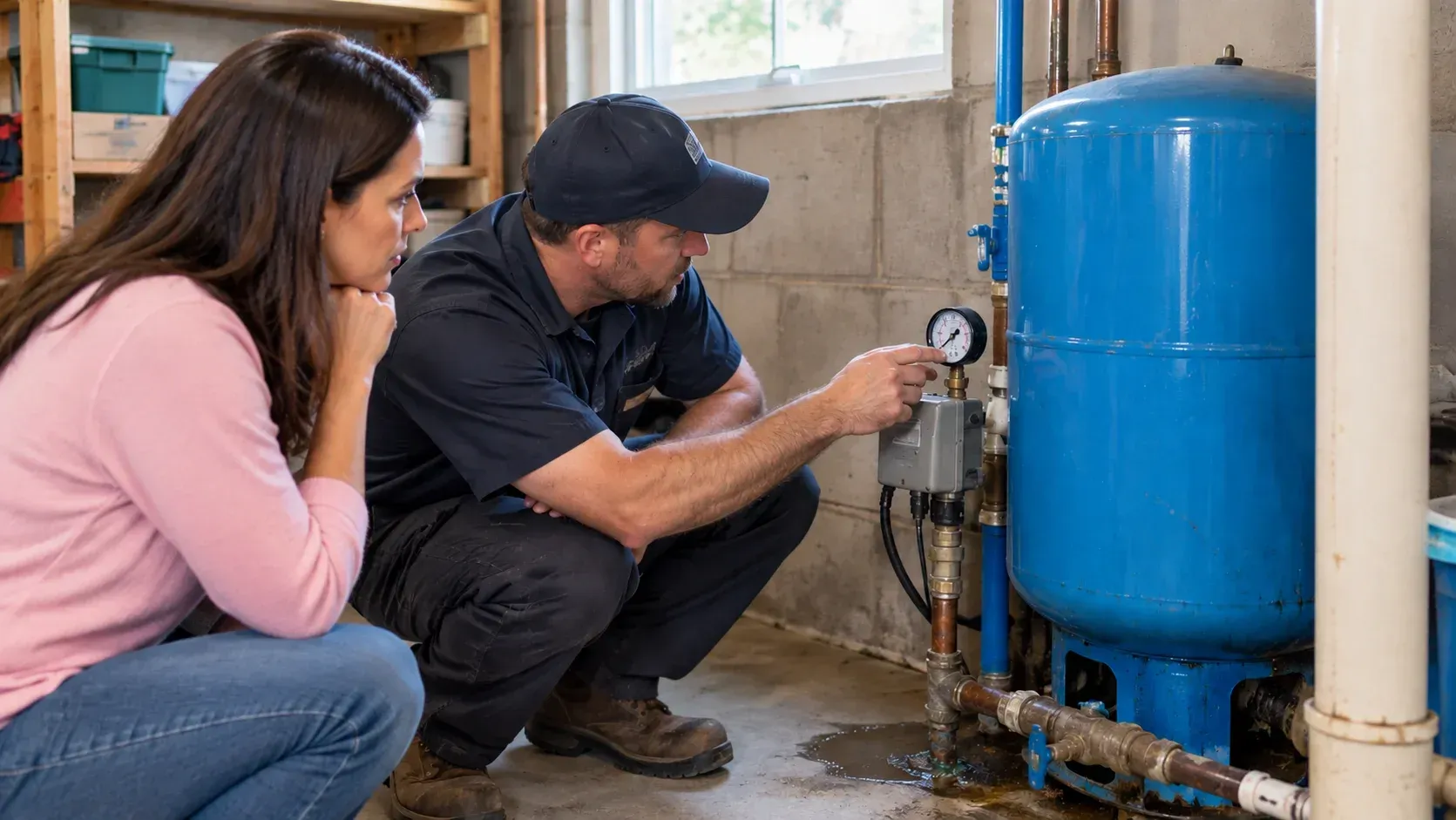
Table of Contents
- Introduction
- The Early Signs of a Well Pump Failing
- Why Rapid Cycling Is the Symptom That Matters Most
- Low Water Pressure From a Well Has Several Causes
- Sounds, Sputtering, and Dirty Water
- Well Pump Problems That Are Really Tank Problems
- Repair or Replace, and What Decides It
- Conclusion
- Schedule a Well Pump Diagnostic
- Frequently Asked Questions
Key Takeaways
- Pressure that swings while a tap runs is usually the first honest warning.
- Rapid cycling on and off is the symptom most likely to destroy the pump if ignored.
- Sputtering air at the faucet often means the water level, not the pump, is the problem.
- A rising electric bill with no other explanation can be a pump running far more than it should.
- Many suspected pump failures turn out to be the pressure tank or the pressure switch, which cost far less to fix.
Introduction
A well pump failing usually shows itself through pressure that will not hold steady, a pump that switches on and off rapidly, sputtering or air at the taps, and an electric bill climbing for no clear reason. Any one of those is worth attention. Two or more together generally means something in the system is already working harder than it was designed to.
The good news for homeowners across Anne Arundel and northern Calvert County is that several of these symptoms point to parts that are far cheaper to replace than the pump itself. Knowing which is which is most of the value in catching it early.
The Early Signs of a Well Pump Failing
The first signals are usually about consistency rather than total loss of water.
What to watch for:
- Pressure that fluctuates while a shower or tap is running steadily
- Slow recovery after heavy use, where it takes longer than it used to for pressure to come back
- The pump running longer than it once did to accomplish the same thing
- Higher electricity use with no other change in the household
- Water that runs out during longer showers or back to back loads of laundry
None of these mean the pump has failed. They mean something has shifted. A system in good shape delivers water the same way today as it did last year, and a change in that pattern is information worth acting on.
Why Rapid Cycling Is the Symptom That Matters Most
A pump that switches on and off repeatedly during a single use is doing the most damage to itself, which is why this one should not wait.
Cycling is normal. The pump runs, fills the tank, shuts off, and stays off until pressure drops. What is not normal is that sequence repeating every few seconds while you run one faucet. Each start draws far more current than running does, and the repeated starting is what wears motors out early.
The causes vary, and several of them are not the pump:
- A pressure tank that has lost its air charge, so it holds almost no water
- A failing pressure switch sending bad signals
- A leak on the pressure side bleeding off pressure continuously
- A pump genuinely losing capacity
That order matters. The first three are smaller repairs. A pump that is cycling hard because the tank is waterlogged will eventually fail from the cycling, which means the tank problem turns into a pump problem if nobody catches it.
Low Water Pressure From a Well Has Several Causes
Low pressure is the symptom people notice first and the one that proves the least on its own, because the cause sits anywhere between the water in the ground and the fixture in your hand.
The possibilities, roughly from cheapest to most serious:
| Where the problem is | What it usually looks like |
|---|---|
| Clogged sediment filter | Pressure drops gradually, improves after a filter change |
| Pressure switch setting | Pressure is steady but low at every fixture |
| Waterlogged pressure tank | Pressure swings and the pump cycles rapidly |
| Clogged or corroded piping | One area of the house is worse than the rest |
| Failing pump | Pressure falls off under sustained demand |
| Dropping water level | Air and sputtering mixed with the low pressure |
In homes on municipal supply, water pressure drops usually trace back to corroded piping or a failed regulator. On a well, the list is longer and the pump is only one item on it. Starting with the cheapest check rather than assuming the worst is both the sensible order and the one a good plumber will follow.
Sounds, Sputtering, and Dirty Water
Changes in sound and water quality are the symptoms homeowners dismiss, and they often carry the most specific information.
Air and sputtering at the tap usually means air is entering the system. On a submersible pump, that can point to a dropping water level in the well, where the pump is periodically pulling air instead of water. That is a well problem rather than a pump problem, and it changes the conversation entirely.
Grinding, clicking, or a loud hum from a jet pump or the pressure switch points at mechanical wear or an electrical fault. A pump that is audibly straining is usually telling you something real.
Sediment, grit, or cloudy water can mean a failing pump is pulling from lower in the well and bringing material with it. It can also mean the well itself has changed. Either way, a change in water appearance is worth separating from a change in water safety, and routine well water testing answers the second question rather than the first.
Well Pump Problems That Are Really Tank Problems
A surprising share of suspected pump failures turn out to be the pressure tank, which is good news because it is the less expensive fix.
The pressure tank stores water under pressure so the pump does not have to start every time someone runs a tap. Inside most tanks is a bladder separating water from a charge of air. When that charge is lost or the bladder fails, the tank holds almost nothing, and the pump starts and stops constantly to compensate.
The symptoms look almost identical to a dying pump: rapid cycling, pressure that will not hold, a pump running far more than it should. The difference is the diagnosis, not the symptom list.
The pressure switch is the other common culprit. It is the component that tells the pump when to run, and when it fails or its contacts foul, the pump either runs when it should not or refuses to start at all. Both parts are routinely replaced and neither requires touching the pump.
Repair or Replace, and What Decides It
Whether a failing pump gets repaired or replaced usually comes down to where the pump sits, how old it is, and what actually failed.
The factors that drive the decision:
- Submersible or above ground. A submersible pump has to be pulled from the well to be worked on, so the labor to reach it is the same whether you repair or replace.
- Age. A pump near the end of its service life rarely justifies a significant repair.
- What failed. A control component is a repair. A seized motor or a worn impeller usually is not.
- Whether the cause is fixed. Replacing a pump that failed from cycling, without fixing the tank that caused the cycling, buys you the same failure again.
- Well conditions. If the water level has dropped, the right answer may involve the well rather than the pump.
That fourth point is the one worth insisting on. Any plumber replacing a pump should be able to tell you why the old one died. If nobody can answer that, the new pump is inheriting the same conditions.
Conclusion
A well pump rarely fails without warning. It warns through pressure that will not hold, cycling that speeds up, air at the taps, and power use that climbs. The useful move is to treat those as system symptoms rather than pump symptoms, because the pressure tank and pressure switch cause most of the same complaints and cost considerably less to put right. Get it looked at while the water is still running. Diagnosing a struggling system is a routine visit. Replacing a seized pump on a Sunday is not.
Schedule a Well Pump Diagnostic
If your water pressure has changed, your pump is cycling hard, or your taps are sputtering, we will find out why before anything gets replaced. GAD Plumbing has served Anne Arundel and northern Calvert County since 1980, we are fully licensed and insured, and we offer free same business day estimates plus 24/7 emergency response when a well goes down. Call us about
well pump services and we will start with diagnostics, not a sales pitch.
Frequently
Asked Questions
What are the first signs a well pump is going bad?
Pressure that fluctuates while a tap runs steadily, slower recovery after heavy use, the pump running longer than it used to, and a rising electric bill with no other explanation. Air or sputtering at the faucet is another early signal worth acting on.
Why does my well pump keep turning on and off?
Rapid cycling usually means the pressure tank has lost its air charge, the pressure switch is failing, or there is a leak bleeding pressure off. It can also mean the pump is losing capacity. Cycling wears pumps out quickly, so it should not be left alone.
Can a bad pressure tank feel like a failing well pump?
Yes, and it often does. A waterlogged tank causes rapid cycling, unstable pressure, and a pump that runs far more than it should, which are the same symptoms as a dying pump. The tank is usually the less expensive repair.
Why is there air in my well water lines?
Air at the taps often means the pump is periodically drawing air instead of water, which can indicate a dropping water level in the well. It can also come from a leak on the suction side. Either way it points to the system rather than just the pump.
Should a failing well pump be repaired or replaced?
It depends on the pump type, its age, and what failed. Submersible pumps have to be pulled either way, so labor is similar. Control components are usually repairs. A seized motor usually is not. The cause should always be identified first.